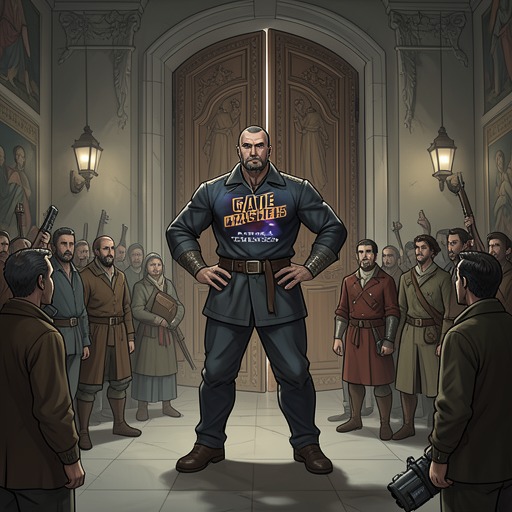
Turemok
Gate CrashersThe Turemok are a heavily militarized species whose presence combines bodily intimidation with institutional violence. Their most consequential representatives are not simply individual antagonists but products of a hierarchy that turns insecurity into discipline, discipline into expansion, and expansion into a self-justifying security system. The species’ conflict with humanity therefore develops as both a military confrontation and a struggle over who has the authority to classify another people as animals, criminals, or a legitimate civilization.
Physical Presence and Social Hierarchy
The Turemok are described as resembling the grotesque result of a drunken encounter between a Gila monster and a hyena, an image that makes their alienness deliberately difficult to domesticate. Even among their own crew, Vel Noric is imposing: he stands nearly an entire crest above everyone else aboard and outweighs his nearest competitor by twenty percent. His stature is not merely an accident of biology. Noric has cultivated favors within the personnel-assignment hierarchy, ensuring that his first crew is unusually small and therefore easier for him to control.
This hierarchy is organized around rank, physical dominance, and survival rather than retirement or institutional continuity. Noric chooses J’quol as his Hedfer-Vel because the subordinate is deferential, unambitious, and too slight to act on any ambition he might accidentally develop. The practice reflects a system in which former commanders are rarely available to claim benefits because they are generally dead. Subordination is consequently not a ceremonial relationship but a defensive arrangement, designed to prevent the next rung of authority from becoming an immediate threat.
The Pal’kuar dominance rite makes this social order explicit. Since Noric became Vel, there has been only one such contest, and its final outcome has served as insurance against another during his tour. Authority is therefore secured not by stable law alone but by the visible possibility of lethal challenge and the memory of what happened when that challenge was last made. The Turemok command structure presents hierarchy as both government and predator ecology: the superior survives because rivals understand what advancement may cost.
Militarization and Historical Insecurity
The Turemok military system is inseparable from the species’ history. Noric recalls that the Turemok were once galactic infants, technologically stagnant and confined to their home world of Faan. Centuries of Lividite aggression forced neighboring societies into desperation, and the Turemok were transformed from a constrained population into a spear aimed at the heart of the Lividite enemy. Once that purpose had been fulfilled, however, the military could not be safely dismantled. Millennia later, the Turemok remain the talons of the Assembly, preserving their position through merciless readiness.
This history explains why technological news is heard as an existential threat. When Noric is asked to consider the possibility that humans have already opened their own high-space portal, the question strikes at more than tactical advantage. It suggests that humanity may soon escape the enclosure that the Turemok and the wider galactic order have treated as natural. The Turemok respond to uncertainty by converting it into a military problem: a potential rival must be contained before its capabilities become undeniable.
The same security logic is visible on the human side. After the discovery of the buoy and the warning about the Human Wildlife Preserve, human leaders conclude that a deterrent is necessary in case first contact turns hostile. The resulting parallel is crucial. Humanity arms itself because it believes it is being caged; the Turemok defend their military monopoly because they believe new human technology threatens the order that gave their species purpose. Each side experiences its own escalation as defensive, while the other side experiences it as proof of hostile intent.
The Turemok as Enforcers and Captors
The species’ institutional violence becomes concrete in its treatment of the human crew. Zek’nel, a member of the Turemok Pacification Force, appears as an enormous, razor-edged bipedal figure whose predator’s eyes glow crimson. His visual introduction turns the Turemok into a displayed threat before he speaks. He then orders the humans to surrender under suspicion of the geocides of Culpus-Alam and Okim, giving them only twenty rakims to comply before force will be used.
Vel Noric embodies a more controlled version of the same menace. When the prisoners are brought into a nearly empty room containing an oversized metal chair made of right angles, Noric occupies the doorway and presents himself as both jailer and interpreter of human culture. He demands admissions concerning Culpus-Alam, Okim, and Kulla, offering relief from future anguish in exchange for confession. His invocation of the human line,